1) The Hook
Three problems kept repeating in long coding runs: the agent paused mid-task to ask clarifying questions, checklist items got marked done without real verification, and context bloat made later steps drift.
I needed execution that stayed mostly hands-off once started, with verification gates that actually held. Roo Code orchestrator solved this by splitting one large objective into scoped subtasks with explicit completion criteria and tighter context boundaries.
2) Context & Constraints
My baseline was the standard “one big prompt” workflow in a single coding session. That pattern is fine for short edits. It degrades when work spans planning, implementation, validation, and review.
My Requirements
- Minimal human intervention during execution: questions should be asked upfront, not in the middle of the run.
- Checklist reliability: items are not complete until they are both implemented and verified.
- Tight handoffs between steps: each subtask should carry only the context required for that step.
I treat the orchestrator as a PM control loop, not a magic single developer: define scope, assign work, verify outputs, then move to the next milestone.
Environment Limitations
- Provider behavior in my setup: I run Roo Code through VS Code’s LLM API provider path.
- Effective context cap at product layer: in practice this surfaces as an effective window commonly around ~64K-128K, even when a model’s native limit may be higher.
- Practical implication: context carry-over must be managed aggressively on long, multi-phase tasks.
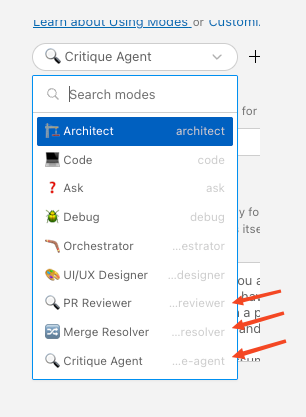
Rejected alternatives:
- One giant prompt in a single Code session — rejected because prior outputs accumulate and increase drift/retry cost.
- Manual copy/paste across separate chats — rejected because coordination overhead is high and state tracking is fragile.
I also tested Claude Code agent teams but found them harder to control for this workflow shape.
3) The Approach
I used role-specialized routing as an explicit engineering decision:
- Opus for orchestration and decomposition (as of early 2026)
- Sonnet for implementation-heavy file operations (as of early 2026)
- GPT/Codex reserved in routing policy for debugging-heavy branches when needed
The key principle: model roles are moving labels, not constants. I route by task signals (complexity, ambiguity, failure mode), not by static model branding.
Instead of forcing one agent to hold everything, I decomposed work into 8 subtasks with explicit acceptance criteria. Each subtask received minimal context and returned a compact handoff to the orchestrator.
Trade-off: orchestration adds setup and validation overhead. Payoff: less context bloat, cleaner retries, and higher completion reliability across multi-concern workflows.
4) The Implementation
I used a real workflow: setting up my personal blog.
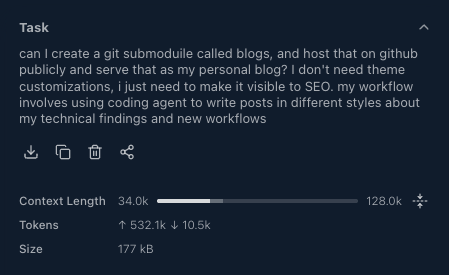
Step 1 — Seed orchestrator with the objective and constraints
The orchestrator session used ~34K out of 128K (including system prompts + history) because most execution context lived in delegated subtasks.
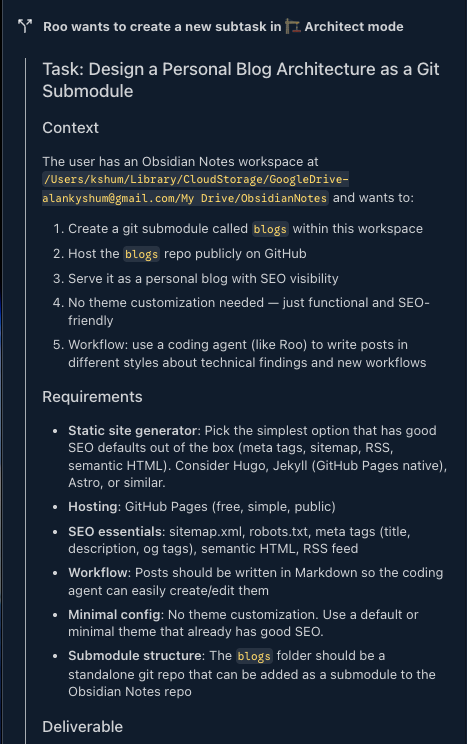
Step 2 — Delegate discovery to Architect mode
Architect mode mapped folder structure and constraints before implementation.
Step 3 — Run sequentially with checklist gating
Progress only advanced when each subtask met its acceptance condition.
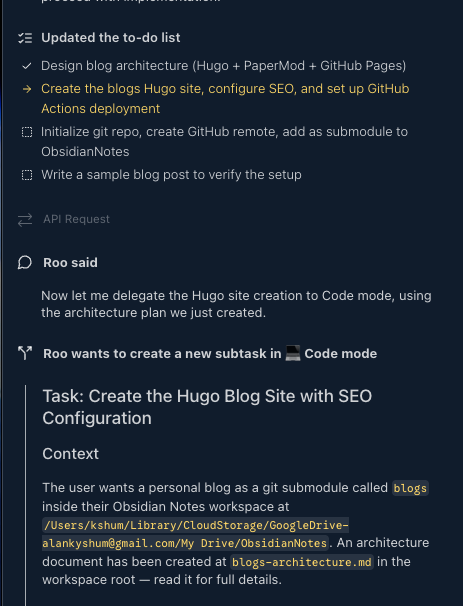
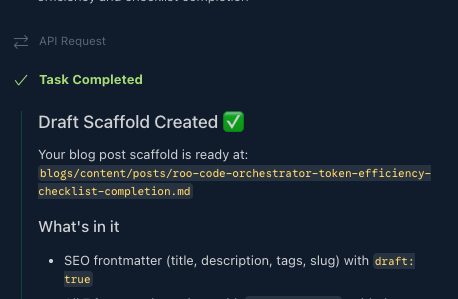
Step 4 — Close on a fully completed checklist
The run ended with an auditable checklist across all delegated steps.
Task Timeline — reported by Roo Code
| # | Subtask | Agent Mode | Duration |
|---|---|---|---|
| 1 | Design blog architecture (Hugo + PaperMod + GitHub Pages) | 🏗️ Architect | ~1 min |
| 2 | Create Hugo site, configure SEO, GitHub Actions deployment | 💻 Code | ~4 min |
| 3 | Init git repo, create GitHub remote, add as submodule | 💻 Code | ~3 min |
| 4 | Write sample blog post, build, push, trigger deploy | 💻 Code | ~2 min |
| 5 | Analyze ObsidianNotes workspace for themes & patterns | ❓ Ask | ~1 min |
| 6 | Create write-blog-post Roo skill | 💻 Code | ~2 min |
| 7 | Refine skill with 7-section framework + 3-phase workflow | 💻 Code | ~2 min |
| 8 | Bootstrap draft scaffold for orchestrator blog post | 💻 Code | ~2 min |
| — | Total | 🪃 Orchestrator (coordinator) | ~14 min |
6 of 8 subtasks ran in 💻 Code mode. The orchestrator mostly handled routing, scoping, and acceptance control.
Minimal scoped subtask instruction example:
Task: Create Hugo site skeleton and PaperMod config only.
Scope: Touch files under blogs/ only. Do not run git push. Do not create blog content.
Output contract:
1) List files created/changed.
2) Show final config keys changed.
3) Confirm `hugo --minify` passes.
5) Results & Numbers
These are run-level observations from one workflow, not controlled benchmarks.
Quantified scoped-context impact:
- Orchestrator session consumed ~34K/128K (full coordinator context, including system prompts + history).
- Delegated subtask instruction payloads summed to ~14K (estimated).
- Equivalent single-session carry-over for this workflow was estimated around ~40-60K+.
| Dimension | 🪃 Orchestrator (observed) | 💻 Code Only (estimated for same workflow) |
|---|---|---|
| Context growth pattern | Fresh scoped contexts per subtask (~2-4K each) + compact handoffs | One accumulating conversation with prior file reads + command outputs |
| Token efficiency | ~14K total delegated payload | ~40-60K for equivalent multi-step flow |
| Failure blast radius | Failed step retries in isolation | Failures can force broader re-validation/rework |
| Task drift risk | Lower, due to explicit step scope and output contracts | Higher, as objectives and artifacts compete in one context |
| Estimated elapsed time | ~14 min | ~20-30 min |
Wins vs misses:
- Improved: checklist completion reliability, retry containment, token discipline.
- Still expensive/slow: orchestration setup overhead and manual judgment on when to reset context.
6) Lessons Learned
When Code-only is fine
- Tasks with ≤3 steps
- Tasks that don’t require broad file exploration
- Tasks where every step shares the same active context (for example, focused module refactors)
When Orchestrator wins
- Workflows with 5+ distinct steps across different concerns
- Research → design → implement → verify chains
- Cases where only distilled outputs should flow to downstream steps
Practical takeaways
- Scope quality dominates model quality in long runs. Better decomposition beat “stronger model” assumptions.
- Ask early, execute uninterrupted. Front-loading questions reduced mid-run stalls.
- Verification must be explicit. Checklist completion improved only after adding acceptance gates and concrete output contracts.
- Reset aggressively on objective shifts. Weakly related follow-ups after “done” caused relevance failures more often than fresh runs.
- Treat orchestration as control-plane engineering. The value is not parallelism by default; it’s bounded context, measurable handoffs, and controlled retries.
7) What’s Next
Open questions I want to test:
- Can subtask sizing be automated from token budget + dependency graph + risk score?
- What memory retrieval policy preserves continuity without re-inflating context?
Known limits so far:
- Cross-subtask state gets fuzzy when outputs are underspecified.
- Follow-up tasks after “done” often fail relevance checks unless I restart with a fresh objective package.
- Parallel agent workflows can increase token burn quickly without strict output contracts.
I am also evaluating Claude Code agent teams as a comparison point, especially for parallel execution visibility and explicit usage boundaries.
I’m interested in concrete restart heuristics from real teams: the measurable signal you use to terminate an orchestration run, reset context, and relaunch cleanly.